✨ Calm support for bedtime, focus and overwhelm, Free for 14 days. No card needed
✨ Calm support for bedtime, focus and overwhelm, Free for 14 days. No card needed
✨ Start your free trial today!


Back to School Sleep: Why the Routine Matters More Than the Bedtime
Back to School Sleep: Why the Routine Matters More Than the Bedtime
In partnership with The Sleep Charity, for Sleeptember 2026
When the kids are back to school and sleep falls apart, you’re looking for ways to make bedtime easier. When working out a routine that actually works, start with the run-up to bedtime rather than the bedtime itself. A 2024 study of six-year-olds found that consistency mattered more for emotional and behavioural regulation than either how long children slept or how well they slept. A child whose bedtime moved by twenty minutes across the week coped better than a child whose bedtime moved by two hours. So if you are looking at September wondering how to fix everything at once, that is the place to begin. Same shape, same order, same sounds each evening.
That, far more than any single bedtime, is what a back to school sleep routine is really built on - habits, routine, and consistent patterns.
Why does sleep fall apart when school goes back?
Almost everything changes at the same time. The alarm moves. The house gets louder in the mornings. There is a new classroom, possibly a new teacher, a new seat, and a fresh set of social rules to work out. For six weeks the days had very little shape, and now they have a very specific one that they’re expected to slot right in to.
Children carry all of that home with them, and not usually in words. It tends to arrive at half past seven as a meltdown about a toothbrush, or as a child who has held it together beautifully all day and finally lets go the moment the lights go off. One parent put their child’s version of it plainly:
“She doesn’t want to talk about it. She just shuts down.”
For neurodivergent children this is amplified. If a nervous system is already working harder to filter noise, light, texture and social information, a change this size costs more. The tiredness is real, but so is the effort of coping, and the two do not cancel each other out. They stack.
Is it the bedtime or the routine that matters more?
Mostly the routine, and that surprises a lot of people.
A 2024 study published in the Journal of Developmental and Behavioral Pediatrics followed 143 six-year-old children from the INSIGHT cohort. The children wore wrist monitors for a week so their sleep could be measured properly rather than estimated, then researchers watched how they handled a deliberately frustrating task and a cooperative one with their parents. The children with consistent bedtimes regulated better. The ones whose schedules moved around showed more impulsivity and less control. What stood out is that the consistency mattered more than either duration or quality.
That is good news for most families, and a relief for a few. You do not have to win the argument about the perfect bedtime, or hit a number you read somewhere. You have to make the shape of the evening recognisable.
It also matches what parents tell us about what they will actually sustain. One parent, describing what would make them try something new, said they wanted a tool that “would fit into the routine we already have rather than changing it.” Nobody in September has the capacity to rebuild the evening from nothing.
Does a bedtime routine help the rest of the family?
Yes, and it is the effect that gets talked about least.
A randomised controlled trial published in the journal Sleep in 2009 put 405 families through a three week study. Half introduced a consistent nightly routine, and half carried on as they were. The children in the routine group fell asleep faster and woke less often, which you would expect. The finding that has stayed with us is that the mothers’ mood improved significantly too, while the control group’s did not.
That study was carried out with infants and toddlers rather than school-age children, so it is not a direct read-across to a seven-year-old. But it names something almost every parent recognises, and it is the single most consistent theme in our own parent interviews this year. Every single parent we spoke to raised the impact on the whole family without being asked about it.
“It affects everyone around them and it has this ripple effect,” one parent told us.
Another put it more simply. “Even one calmer evening changes the whole feel of the house.”
And a third, whose child is autistic and whose nights come in fits and bursts: “When it’s 24-7, you run out of resilience yourself sometimes.”
Routines do more than improve the night. What they give you is the following day, for everybody in the house. A calmer night is a calmer morning, a shorter argument about shoes, a sibling who also got some rest, and an adult with a little more left in the tank by four o’clock the next afternoon.
What parents told us this year
Between June and July 2026 we ran a series of in-depth interviews with parents, which we refer to throughout as the HushAway® Parent Research 2026. It is a small qualitative study rather than a survey, so we hold the findings lightly. But one of them reorganised how we think about the content we make.
Parents are not searching in labels.
Almost nobody led with a diagnosis. They led with what was happening in their house at nine o’clock at night. One parent summed it up better than any strategy document could: “I didn’t focus very much on the neurodivergency. I just focused on, it’s a challenge, and I need to figure out what to do.”
Another, whose child is awaiting an autism assessment, said: “We’re still waiting for a diagnosis, but the challenges are there regardless.”
And a third, waiting on assessments for two of their children: “The system needs the diagnosis. I don’t.”
That one stays with you. The label is a key that unlocks services. It is not what a parent needs at bedtime on a Tuesday in September. One parent told us they knew something was different when their child was eighteen months old, and that formal diagnosis took roughly five years. Another said they had to “literally beg the health visitor to confirm that I’m not crazy.”
Most of what exists online is organised by diagnosis, which quietly leaves out everyone still waiting, everyone who has chosen not to pursue an assessment, and everyone whose child does not fit neatly into either category. We would rather start with the challenge in front of you.
It is rarely only about sleep
Every parent we interviewed raised transitions, and every one raised routine and structure. Sleep matters, but it sits inside something larger.
“Everything comes back to regulation,” one parent said, and that has become the frame we use internally. Another was blunt about it: “It shouldn’t just be bedtime.”
September is one long transition, which is why it hurts. Holiday to term, playground to classroom, screen to sleep. One parent described their evening problem exactly: “It’s getting them off Minecraft and Fortnite. It’s that transition to get him to calm down.”
Bedtime is simply the transition that costs families the most, because it is the one where everybody is already tired.
What if your child cannot follow a routine at all?
This is the question we are asked most, and it is a fair one. A lot of calming tools assume a child who can sit still, hear an instruction and follow it. Notice your breathing. Squeeze your hands. Picture somewhere peaceful. If a child is already past the point of processing language, those instructions do not land, and they can feel like one more demand at exactly the moment demands are unbearable.
HushAway® is low-demand and instruction-free, so it works when a child is already overwhelmed, with no “calm down” steps required. There is nothing for the child to do. They do not have to participate, respond, or get it right. The sound does the work, using Solfeggio frequencies, binaural beats and ASMR-informed soundscapes, and the child is allowed simply to be in the room while it happens.
One parent described the moment it worked for their child: “She settles. I can just feel her body relax.” Another set the expectation about as honestly as it can be set: “It wasn’t about fixing everything. It just helped make the evenings calmer.”
That is the right bar to set. Not transformation, just a calmer evening.
Is this not what Calm or Moshi already do?
One of the parents we interviewed asked us this directly, and it is the best question in the whole study: “If I had Calm, what is going to make parents choose HushAway® instead?”
The honest answer is that the difference sits in where each one started.
Calm and Headspace were built for adults and then adapted for children. Moshi built a well-loved library of sleep stories for a broad audience. They all do what they do well, and several of the parents we spoke to already subscribe to one of them. But each begins from a neurotypical listener and widens out from there, which is why so much of the guidance inside them still assumes a child who can follow along.
HushAway® is built from the ground up for neurodivergent children, not neurotypical content relabelled. Every design decision started in that place: no instruction, no pressure to engage, no assumption that the child is calm enough to begin. The library is customisable because what soothes one autistic child overstimulates another, and we would rather build for that than pretend otherwise.
We are UK-based, research-informed, and backed by our Circle of Experts and SoundSonic® Ambassadors. The Circle is eleven doctors, researchers, teachers and practitioners who sit behind the work rather than on the marketing. The Ambassadors are real families across the UK, the United States, Australia, New Zealand, South Africa and South East Asia who have been using this with their own children for over 18 months, rather than a focus group over an afternoon.
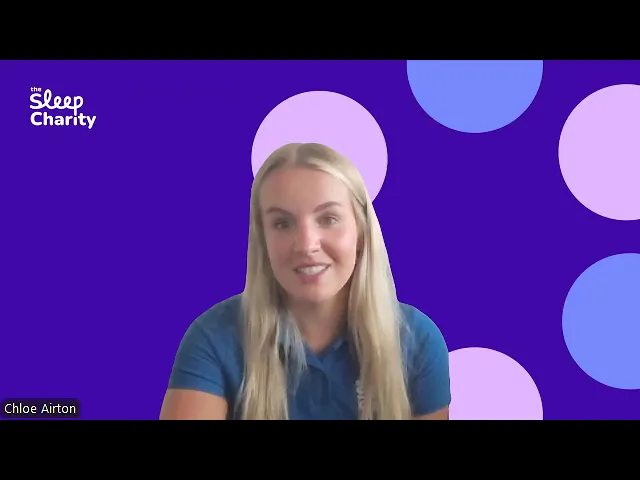
A short school readiness recording from The Sleep Charity
We are proud to be a partner of The Sleep Charity through 2026, and they have recorded a short school readiness piece especially for this article. It is deliberately brief, because September is not the month anyone has a spare half hour.
Where to start this week: building a back to school sleep routine
Pick the order and keep it. The same three or four things, in the same sequence, every night. The content matters less than the repetition.
Fit it around the routine you already have. Do not rebuild the evening in the first week of term. Add one predictable element and let it settle.
Start the wind-down earlier than feels necessary. Most children need longer to come down than the routine allows for.
Use sound as the signal. Children learn quickly that a particular soundscape means the day is closing, and that association does a great deal of work over time.
Do not aim for silence. A quiet room can be surprisingly loud for a child who is listening out for every noise in the house.
Try a speaker rather than a phone. One parent in our research pointed out that “the phone is a screen and a screen is for visual stimulation.” A child who associates any screen with YouTube will settle far more easily if the sound simply fills the room.
Expect the first fortnight of term to be harder. A wobble in September is not a sign the routine has failed.
Protect your own wind-down too. Both the research and every parent we interviewed point the same way on this one.
Try it with your own family
The Sound Sanctuary holds hundreds of stories, affirmations and soundscapes, and there is a 14-day free trial of the Sound Sanctuary membership, with a hand-picked selection from the full library, free before any payment. If you are rebuilding routines this September, a fortnight is enough time to find out whether it works for your child before you decide anything at all. Start your free 14-day trial.
A gentle note
HushAway® is designed to support emotional regulation, sleep routines and focus. It is not a replacement for medical care, therapy, or personalised clinical advice. If you use headphones with children, safe listening levels matter, and your clinician or school health team can advise on what is appropriate.
About the HushAway® Parent Research 2026
The parent quotes in this article are drawn from the HushAway® Parent Research 2026, a series of in-depth interviews carried out between June and July 2026 with UK-based parents of children aged five to fourteen. The sample included families with diagnosed ADHD and autism, families awaiting assessment, families with no diagnosis at all, and one family whose child is neurotypical. All quotes are used anonymously with permission.
This is qualitative research on a small sample. We present it as what parents told us rather than as statistical evidence, and we would rather say that plainly than dress it up as something it is not.
References
HushAway®. HushAway® Parent Research 2026: in-depth parent interviews, June to July 2026. HushAway®, 2026.
Dadzie A, Buxton OM, Master L, Hohman EE, Paul IM, Williams JS, Acton EH, Tauriello S, Anzman-Frasca S. Associations Between Sleep Health and Child Behavior at Age 6 Years in the INSIGHT Study. Journal of Developmental and Behavioral Pediatrics, 2024. https://pubmed.ncbi.nlm.nih.gov/39514718/
Mindell JA, Telofski LS, Wiegand B, Kurtz ES. A nightly bedtime routine: impact on sleep in young children and maternal mood. Sleep, 2009;32(5):599-606. https://pubmed.ncbi.nlm.nih.gov/19480226/
In partnership with The Sleep Charity, for Sleeptember 2026
When the kids are back to school and sleep falls apart, you’re looking for ways to make bedtime easier. When working out a routine that actually works, start with the run-up to bedtime rather than the bedtime itself. A 2024 study of six-year-olds found that consistency mattered more for emotional and behavioural regulation than either how long children slept or how well they slept. A child whose bedtime moved by twenty minutes across the week coped better than a child whose bedtime moved by two hours. So if you are looking at September wondering how to fix everything at once, that is the place to begin. Same shape, same order, same sounds each evening.
That, far more than any single bedtime, is what a back to school sleep routine is really built on - habits, routine, and consistent patterns.
Why does sleep fall apart when school goes back?
Almost everything changes at the same time. The alarm moves. The house gets louder in the mornings. There is a new classroom, possibly a new teacher, a new seat, and a fresh set of social rules to work out. For six weeks the days had very little shape, and now they have a very specific one that they’re expected to slot right in to.
Children carry all of that home with them, and not usually in words. It tends to arrive at half past seven as a meltdown about a toothbrush, or as a child who has held it together beautifully all day and finally lets go the moment the lights go off. One parent put their child’s version of it plainly:
“She doesn’t want to talk about it. She just shuts down.”
For neurodivergent children this is amplified. If a nervous system is already working harder to filter noise, light, texture and social information, a change this size costs more. The tiredness is real, but so is the effort of coping, and the two do not cancel each other out. They stack.
Is it the bedtime or the routine that matters more?
Mostly the routine, and that surprises a lot of people.
A 2024 study published in the Journal of Developmental and Behavioral Pediatrics followed 143 six-year-old children from the INSIGHT cohort. The children wore wrist monitors for a week so their sleep could be measured properly rather than estimated, then researchers watched how they handled a deliberately frustrating task and a cooperative one with their parents. The children with consistent bedtimes regulated better. The ones whose schedules moved around showed more impulsivity and less control. What stood out is that the consistency mattered more than either duration or quality.
That is good news for most families, and a relief for a few. You do not have to win the argument about the perfect bedtime, or hit a number you read somewhere. You have to make the shape of the evening recognisable.
It also matches what parents tell us about what they will actually sustain. One parent, describing what would make them try something new, said they wanted a tool that “would fit into the routine we already have rather than changing it.” Nobody in September has the capacity to rebuild the evening from nothing.
Does a bedtime routine help the rest of the family?
Yes, and it is the effect that gets talked about least.
A randomised controlled trial published in the journal Sleep in 2009 put 405 families through a three week study. Half introduced a consistent nightly routine, and half carried on as they were. The children in the routine group fell asleep faster and woke less often, which you would expect. The finding that has stayed with us is that the mothers’ mood improved significantly too, while the control group’s did not.
That study was carried out with infants and toddlers rather than school-age children, so it is not a direct read-across to a seven-year-old. But it names something almost every parent recognises, and it is the single most consistent theme in our own parent interviews this year. Every single parent we spoke to raised the impact on the whole family without being asked about it.
“It affects everyone around them and it has this ripple effect,” one parent told us.
Another put it more simply. “Even one calmer evening changes the whole feel of the house.”
And a third, whose child is autistic and whose nights come in fits and bursts: “When it’s 24-7, you run out of resilience yourself sometimes.”
Routines do more than improve the night. What they give you is the following day, for everybody in the house. A calmer night is a calmer morning, a shorter argument about shoes, a sibling who also got some rest, and an adult with a little more left in the tank by four o’clock the next afternoon.
What parents told us this year
Between June and July 2026 we ran a series of in-depth interviews with parents, which we refer to throughout as the HushAway® Parent Research 2026. It is a small qualitative study rather than a survey, so we hold the findings lightly. But one of them reorganised how we think about the content we make.
Parents are not searching in labels.
Almost nobody led with a diagnosis. They led with what was happening in their house at nine o’clock at night. One parent summed it up better than any strategy document could: “I didn’t focus very much on the neurodivergency. I just focused on, it’s a challenge, and I need to figure out what to do.”
Another, whose child is awaiting an autism assessment, said: “We’re still waiting for a diagnosis, but the challenges are there regardless.”
And a third, waiting on assessments for two of their children: “The system needs the diagnosis. I don’t.”
That one stays with you. The label is a key that unlocks services. It is not what a parent needs at bedtime on a Tuesday in September. One parent told us they knew something was different when their child was eighteen months old, and that formal diagnosis took roughly five years. Another said they had to “literally beg the health visitor to confirm that I’m not crazy.”
Most of what exists online is organised by diagnosis, which quietly leaves out everyone still waiting, everyone who has chosen not to pursue an assessment, and everyone whose child does not fit neatly into either category. We would rather start with the challenge in front of you.
It is rarely only about sleep
Every parent we interviewed raised transitions, and every one raised routine and structure. Sleep matters, but it sits inside something larger.
“Everything comes back to regulation,” one parent said, and that has become the frame we use internally. Another was blunt about it: “It shouldn’t just be bedtime.”
September is one long transition, which is why it hurts. Holiday to term, playground to classroom, screen to sleep. One parent described their evening problem exactly: “It’s getting them off Minecraft and Fortnite. It’s that transition to get him to calm down.”
Bedtime is simply the transition that costs families the most, because it is the one where everybody is already tired.
What if your child cannot follow a routine at all?
This is the question we are asked most, and it is a fair one. A lot of calming tools assume a child who can sit still, hear an instruction and follow it. Notice your breathing. Squeeze your hands. Picture somewhere peaceful. If a child is already past the point of processing language, those instructions do not land, and they can feel like one more demand at exactly the moment demands are unbearable.
HushAway® is low-demand and instruction-free, so it works when a child is already overwhelmed, with no “calm down” steps required. There is nothing for the child to do. They do not have to participate, respond, or get it right. The sound does the work, using Solfeggio frequencies, binaural beats and ASMR-informed soundscapes, and the child is allowed simply to be in the room while it happens.
One parent described the moment it worked for their child: “She settles. I can just feel her body relax.” Another set the expectation about as honestly as it can be set: “It wasn’t about fixing everything. It just helped make the evenings calmer.”
That is the right bar to set. Not transformation, just a calmer evening.
Is this not what Calm or Moshi already do?
One of the parents we interviewed asked us this directly, and it is the best question in the whole study: “If I had Calm, what is going to make parents choose HushAway® instead?”
The honest answer is that the difference sits in where each one started.
Calm and Headspace were built for adults and then adapted for children. Moshi built a well-loved library of sleep stories for a broad audience. They all do what they do well, and several of the parents we spoke to already subscribe to one of them. But each begins from a neurotypical listener and widens out from there, which is why so much of the guidance inside them still assumes a child who can follow along.
HushAway® is built from the ground up for neurodivergent children, not neurotypical content relabelled. Every design decision started in that place: no instruction, no pressure to engage, no assumption that the child is calm enough to begin. The library is customisable because what soothes one autistic child overstimulates another, and we would rather build for that than pretend otherwise.
We are UK-based, research-informed, and backed by our Circle of Experts and SoundSonic® Ambassadors. The Circle is eleven doctors, researchers, teachers and practitioners who sit behind the work rather than on the marketing. The Ambassadors are real families across the UK, the United States, Australia, New Zealand, South Africa and South East Asia who have been using this with their own children for over 18 months, rather than a focus group over an afternoon.
A short school readiness recording from The Sleep Charity
We are proud to be a partner of The Sleep Charity through 2026, and they have recorded a short school readiness piece especially for this article. It is deliberately brief, because September is not the month anyone has a spare half hour.
Where to start this week: building a back to school sleep routine
Pick the order and keep it. The same three or four things, in the same sequence, every night. The content matters less than the repetition.
Fit it around the routine you already have. Do not rebuild the evening in the first week of term. Add one predictable element and let it settle.
Start the wind-down earlier than feels necessary. Most children need longer to come down than the routine allows for.
Use sound as the signal. Children learn quickly that a particular soundscape means the day is closing, and that association does a great deal of work over time.
Do not aim for silence. A quiet room can be surprisingly loud for a child who is listening out for every noise in the house.
Try a speaker rather than a phone. One parent in our research pointed out that “the phone is a screen and a screen is for visual stimulation.” A child who associates any screen with YouTube will settle far more easily if the sound simply fills the room.
Expect the first fortnight of term to be harder. A wobble in September is not a sign the routine has failed.
Protect your own wind-down too. Both the research and every parent we interviewed point the same way on this one.
Try it with your own family
The Sound Sanctuary holds hundreds of stories, affirmations and soundscapes, and there is a 14-day free trial of the Sound Sanctuary membership, with a hand-picked selection from the full library, free before any payment. If you are rebuilding routines this September, a fortnight is enough time to find out whether it works for your child before you decide anything at all. Start your free 14-day trial.
A gentle note
HushAway® is designed to support emotional regulation, sleep routines and focus. It is not a replacement for medical care, therapy, or personalised clinical advice. If you use headphones with children, safe listening levels matter, and your clinician or school health team can advise on what is appropriate.
About the HushAway® Parent Research 2026
The parent quotes in this article are drawn from the HushAway® Parent Research 2026, a series of in-depth interviews carried out between June and July 2026 with UK-based parents of children aged five to fourteen. The sample included families with diagnosed ADHD and autism, families awaiting assessment, families with no diagnosis at all, and one family whose child is neurotypical. All quotes are used anonymously with permission.
This is qualitative research on a small sample. We present it as what parents told us rather than as statistical evidence, and we would rather say that plainly than dress it up as something it is not.
References
HushAway®. HushAway® Parent Research 2026: in-depth parent interviews, June to July 2026. HushAway®, 2026.
Dadzie A, Buxton OM, Master L, Hohman EE, Paul IM, Williams JS, Acton EH, Tauriello S, Anzman-Frasca S. Associations Between Sleep Health and Child Behavior at Age 6 Years in the INSIGHT Study. Journal of Developmental and Behavioral Pediatrics, 2024. https://pubmed.ncbi.nlm.nih.gov/39514718/
Mindell JA, Telofski LS, Wiegand B, Kurtz ES. A nightly bedtime routine: impact on sleep in young children and maternal mood. Sleep, 2009;32(5):599-606. https://pubmed.ncbi.nlm.nih.gov/19480226/
Make tomorrow feel easier
Whether it’s bedtime battles, big emotions or sensory overload, small sound moments can bring your child the reassurance and stability they need.



Make tomorrow feel easier
Whether it’s bedtime battles, big emotions or sensory overload, small sound moments can bring your child the reassurance and stability they need.
Make tomorrow feel easier
Whether it’s bedtime battles, big emotions or sensory overload, small sound moments can bring your child the reassurance and stability they need.
Founder & Creative Lead - The PeacePath® | Creator of HushAway® Neurodivergent Inclusive Coach | Voice Artist & Storyteller | Sound Therapy Practitioner